SOC Report Structure / Overview

System and Organization Controls (SOC) reports are pretty easy to read once you get a handle of how they’re structured. The reports are typically made up of 4 or 5 sections, not including the cover page and table of contents.

The section details below are provided to give a general idea of what’s included in each section. However, they’re not all inclusive. I’ll go into more detail regarding some of the sections in later posts.

Section I: Independent Service Auditor’s Report

The Independent Service Auditor’s Report includes the scope of the engagement, service organization and service auditor responsibilities, and most important of all, the auditor’s opinion. The opinion will include 2 or 3 statements depending on if it’s a Type 1 or Type 2 report.

A Type 1 report will indicate the description is fairly presented and the controls related to the control objectives were suitably designed as of a specific date (e.g., September 30, 2025).

A Type 2 report will indicate the description is fairly presented, controls related to the control objectives were suitably designed throughout the period (e.g., October 1, 2024 – September 30, 2025), and controls operated effectively to provide reasonable assurance the control objectives were achieved throughout the period (e.g., October 1, 2024 – September 30, 2025).
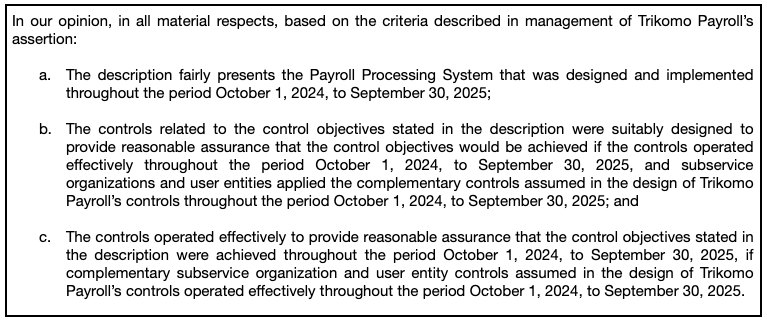
Example SOC 1 Type 2 Opinion

Section II: Management Assertion

The Management Assertion documents, from the management of the service organization perspective, the services included in the scope of the report, any services completed by subservice organizations (if applicable), acknowledges the service organizations responsibilities in fairly presenting system, and that the controls were suitably designed.

The service auditor will typically provide a Management Assertion template to the service organization for review and completion. The service organization has a choice to sign or leave it unsigned in the final report.

Section III: Description of the System

The Description of the System provides an overview of the service organization operations and controls in narrative form. There are certain aspects that are required to be included, while others can be limited by just referencing the control objectives and controls documented in Section IV. I’ve found the best system description includes more detail than just the control objectives / controls and provides a cross reference of controls between both sections.

This section also includes complementary controls for both users (service organization clients) and subservience organizations.

Section IV: Tests of Controls and Results

Control objectives, controls supporting each control objective, tests completed by the service auditor, and test results are noted in this section, typically in table format. The test results would note if any exceptions were noted during testing, even if the report has a “clean opinion.” The best case scenario for the service organization is for the test results to note something in line with “No exceptions noted.” for each control.
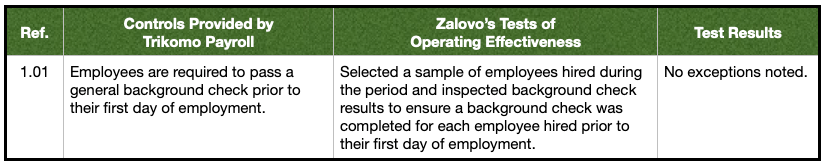
Example control, test of operating effectiveness, and test results.

Section V: Other Information Provided by the Service Organization (Optional)

The Other Information section is optional at the discretion of the service organization. Some companies will use this section to provide additional information about their organization that was not included in the description of the system. This can include other services provided by the organization or future plans for the organization.

Also, in the event there were exceptions / issues noted during testing that were reported in Section IV of the report, some organizations will include additional background regarding the exception(s), action plans to remediate the control weaknesses, and if the action plans were already implemented.

The service auditor will review this section for adequacy, but it’s not subjected to the same procedures applied in forming an opinion. In other words, this section is not tested by the service auditor.

The Manager Assertion, Description of the System, Control Objective and Controls included in the Section IV, and Other Information sections are all provided by the service organization. The only sections / parts noted above that are technically completed by the service auditor are Section I and the tests of operating effectiveness and test results columns included in Section IV.

From Trust, but Verify to Zero Trust to CYA

There’s an aspect to auditing internal controls that has always seemed straight forward to me that for some reason others have trouble grasping. I figure it’s just a personality trait. It doesn’t really matter if the control is financial, operational, or technological, it all boils down to taking the control in question and asking the control owner to “prove it”.

In essence, as an auditor, we’re asking the control owner to prove that the control occurred on a specific day, week, month, or year, depending on the frequency of the control. This thought process has also served me well in the current dis/misinformation age. However, what do we do when the evidence provided is questionable at best? This is being taken to another level now with AI, which allows control owners to create evidence that is perfect. What do we do when the evidence is too perfect?

This ISACA SmartBrief on AI article got me thinking about the topic –> The Audit Evidence Crisis: How AI Deepfakes Are Rewriting Assurance Standards. The article recommends we move on from the “Trust, but Verify” approach to auditing into a new era of “Zero-Trust”.

Why a Zero‑Trust Approach is Essential

A zero‑trust mindset ignites inquisitive and professional skepticism that strengthens the auditor’s ability to:

  • Independently obtain audit evidence from IT and OT environment without interference
  • Validate the authenticity of evidence before relying on it
  • Detect manipulation in digital documents, images, and communications
  • Assess whether controls are resilient against AI‑enabled fraud
  • Reduce audit risk in environments where deception is increasingly automated.

Taking this a step further, this got me to thinking about how audit firms go about what I like to refer as CYA. I’ll refrain from spelling that out in hopes we all know what it means. There are a few steps during an engagement that deal with fraud and non-compliance, which requires the organization being audited to verify (sign) that they are unaware of a fraud or non-compliance.

  1. Contract/Engagement Letter – Signed prior to the engagement, this documents details auditor and client responsibilities, amount other topics. Client responsibilities include notifying the service auditor of any fraud or instances of non-compliance.
  2. Fraud and Non-Compliance Inquiry – Performed during the planning phase, this step involves inquiring with control owners at various levels (e.g., management, staff) whether they are aware of and fraud or instances of non-compliance.
  3. Management Representation Letter – Signed by the client at the completion of the engagement, prior to issuing the final report, this document reiterates responsibilities by the client to notify the auditor of any instances of fraud or non-compliance.

Now, let’s be real. They’re all manual responses and don’t really prove anything, just a CYA for the audit firm. However, I wouldn’t be surprised if audit firms update their engagement letter, fraud and non-compliance inquiry, and representation letter templates to include references to if/when AI is used to create audit evidence. To an extent, it’s already somewhat tangentially included, but it might need to be specifically noted going forward.

SOC Order of Operations

Every so often when scrolling through the interweb I’ll come across a headline stating “95% Get This Simple Math Problem Wrong”. Although some are truly difficult, and I’m not really a fan of the headline, many times completing the equation is just a matter of using standard order of operations. I learned it as PEMDAS growing up (Parentheses, Exponents, Multiplication/Division, Addition/Subtraction).

Although not as stringent, for companies looking to get started with System and Organization Controls (SOC) examinations, there is a recommended order of operations for completing the SOC examinations.

Readiness Assessment:

A readiness assessment is an informal assessment of the organizations policies, procedures, and operations. It’s an ideal starting point for start-ups and companies that haven’t previously completed a formal internal controls examination.

This is an ideal time for the service organization and service auditor to review client contracts to determine what requirements are documented, quantifiable, and can be assessed through an examination.

In essence, it’s a practice run to identify gaps in compliance before undergoing a formal examination to avoid unexpected delays, failed controls, and modified opinions.

Type 1 Examination:

A Type 1 examination assesses the design of controls as of a single point in time. For example, a Type 1 report will typically indicate “As of September 30, 2025.” The report can be used by service organizations to demonstrate to their clients that they’ve implemented formal processes and controls.

It’s common for the Type 1 examination to be completed in short order following the readiness assessment if no major gaps or controls weakness are noted, which can lead to efficiencies and lower the overall cost of the examination.

However, if major gaps or control weakness are noted during the readiness assessment, the Type 1 examination will likely require starting from scratch, after the gaps or control weakness are remediated. Some or most of the evidence previously obtained during the readiness assessment would no longer be valid months after the fact.

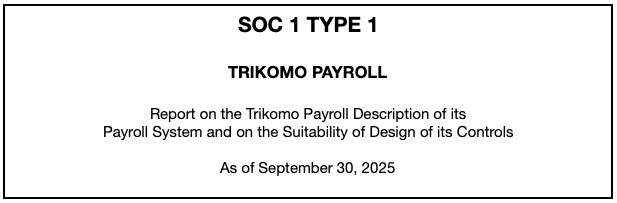
Example SOC 1 Type 1 cover page.

Type 2 Examination:

A Type 2 examination assesses the design of controls AND operating effectiveness during a period of time, usually 9 or 12 months. For example, a Type 2 report will indicate “For the Period October 1, 2024 through September 30, 2025.” This examination involves obtaining populations from the assessment period and selecting a sample of transactions from the population for inspection (testing).

There are unique and rare cases in which the period of time for a Type 2 examination is 6 months. Also, in rare cases, some organizations will complete Type 2 examinations for a 12-month period on a rolling 3-month basis for more continuous monitoring.

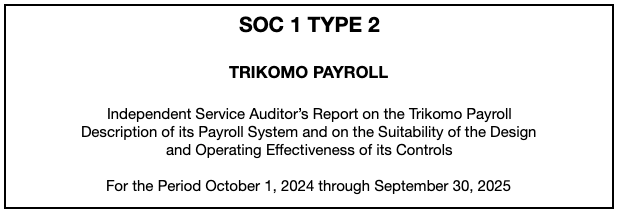
Example SOC 1 Type 2 cover page.

There’s no requirement to go in the above order of operations. However, this approach leads to the best results for the service organization and their clients.