
There are 3 distinct phases during the SOC 1 and SOC 2 examination lifecycle; planning, fieldwork, and reporting. There are a lot of steps that happen behind the scenes within each of these phases, but for purposes of this post we’re mostly going to focus on steps that are more visible to the service organization.
We’re going to use a hypothetical 12-month examination period from October 1, 2024 through September 30, 2025 for this SOC examination lifecycle.
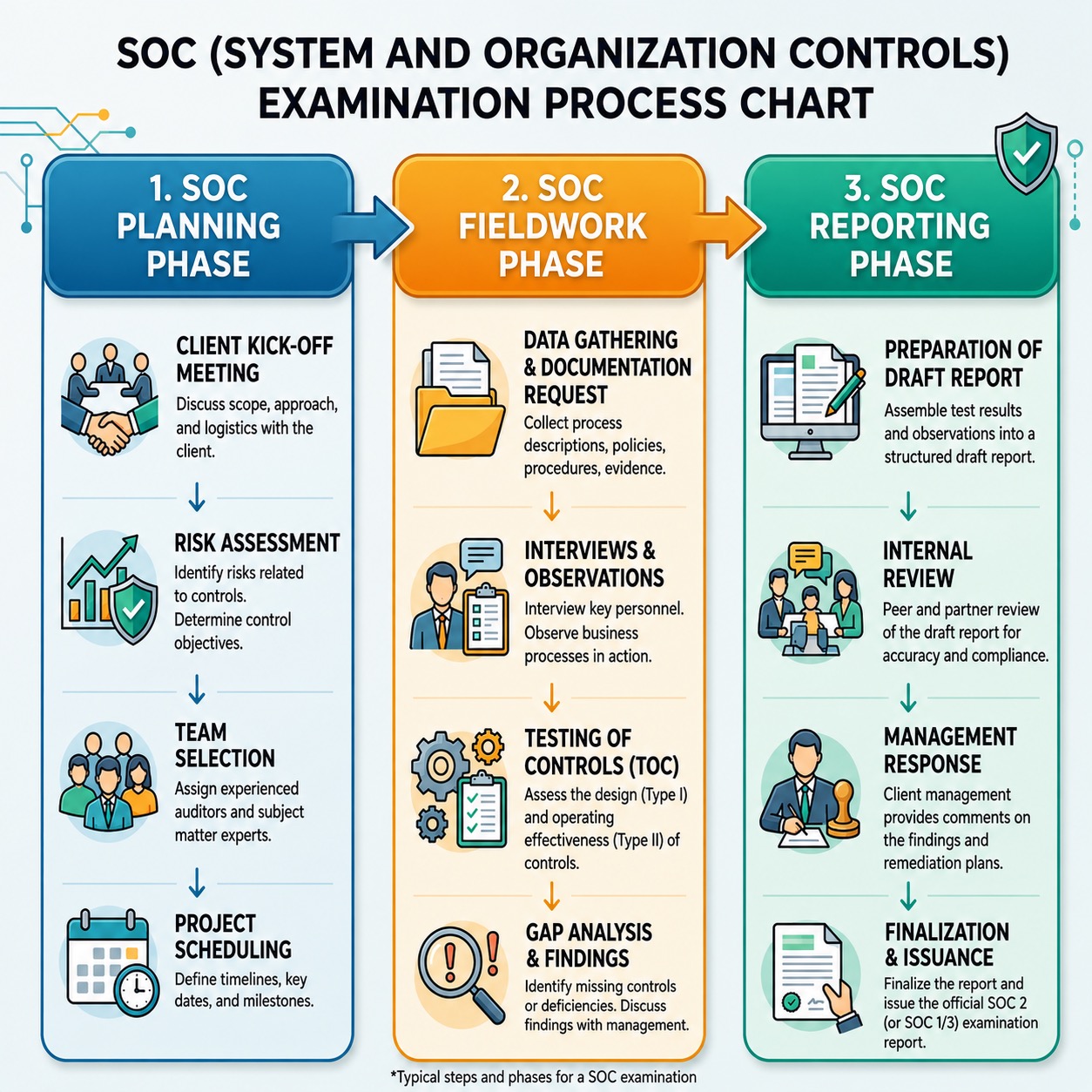
Planning:
The planning phase should start at least 3 months before the end of the examination period, depending on if the project plan includes a single or split fieldwork phase, which we’ll get into in the next section. However, if I had my way, planning would ideally start around 6-9 months before the end of the period.
Using the 12-month examination period example, this would have the planning phase starting in the January to March range. Either way, it’s best to get started as early as possible to allow the service auditor and service organization to properly plan (e.g., assign staff) the project timeline. Included below are various tasks that occur during the planning phase.
Contract / Engagement Letter: The service auditor typically won’t complete any work on the examination until the contract and/or engagement letter is signed by the service organization.
Kick-off Meeting / Entrance Conference: This might be a single meeting or separate meetings depending on the client. Government clients like having a smaller kick-off meeting with project management personnel to set the stage and then follow-up with a more formal entrance conference to include process/control owners. The control matrices (SOC 1 control objectives/controls or SOC 2 criteria/controls) should be provided shortly after the kick-off meeting.
Controls Risk Assessment: The service auditor assesses the controls for design completeness, control significance, and non-compliance risk. This process directly feeds into the document request list (DRL). However, more importantly, this allows the service auditor to determine if there are any major design gaps in the controls that need to be remediated before fieldwork can begin. I’ll get into more detail regarding the risk assessment process in a separate post.
Document Request List: The initial DRL is typically more high level in a first year examination as the service auditor doesn’t have a detailed understanding of the controls yet. During subsequent year examinations, the prior year request list can be used as a baseline for a more thorough initial DRL. The DRL should be provided at least 2 weeks prior to fieldwork and is a living document throughout the examination.
Fieldwork
The fieldwork phase is when the meat of the examination occurs, including interviews, inspections, observations, walkthroughs, and detail tests of controls. Depending on the client and size of the project, this phase can be completed during a single combined fieldwork period or separately as interim and final/year-end fieldwork.
Single Fieldwork: A single fieldwork phase would typically start about 1-2 weeks before the end of the examination period. This would have fieldwork starting during the 2ⁿᵈ half of September using the 12-month example. A single fieldwork phase is common for smaller examinations. However, it’s also not totally uncommon for larger examinations to get a late start and go through a single fieldwork phase.
Split Fieldwork: A split interim and final fieldwork phase is typical for larger examinations. In a split fieldwork scenario, at a minimum, the service auditor will complete interviews with process/control owners to gain an understanding of the control environment and validate the design and accuracy of the controls. If any gaps are identified, the service auditor will work with the service organization to document additional and/or compensating controls.
Using the 12-month examination period example, interim fieldwork would occur sometime between April and July, allowing the service auditor to complete initial testing for 6-9 months worth of transactions. Year-end fieldwork would start the week after the examination period ends, which would be the 1ˢᵗ week of October in the example.
Reporting
The reporting phase will begin approximately 2-4 weeks after the end of the examination period, after all testing is completed. This is highly dependent on how responsive the service organization is in responding to document requests and how quickly the service auditor is able to inspect the documentation. This also assumes no exceptions / finding are noted during testing.
Draft Report: Testing workpapers go through multiple levels of review by the service auditor leading up to issuing the draft report. I’ve had clients request the initial draft report within 15 days after the end of the examination period (e.g., October 15ᵗʰ). However, this puts undue strain on both the service organization and service auditor. Ideally, issuance of the draft report would occur around 4 weeks after the end of the examination period.
Exit Conference: An exit conference is scheduled between the service auditor, project management team, and process/controls owners to discuss the draft report and provide timeframes for any management responses if any findings are identified. The meeting can occur anywhere between 1-2 (or more) weeks after issuing the draft report.
Final Report: The service auditor will request the service organization review and sign various documents prior to issuing the final report, including a management assertion letter and management representation letter. Ideally, the final report is issued approximately 6-8 weeks after the examination period ends. As someone that’s performed examinations with a period ending September 30ᵗʰ quite often, my goal is to have the report finalized before the week of Thanksgiving.
The timing for planning and fieldwork is more condensed for a 9-month examination period (e.g., January 1ˢᵗ – September 30ᵗʰ). However, the reporting phase tends to be about the same.
 Zalovo GRC