SOC Planning – Control Design

System and Organization Controls (SOC) control design involves documenting policies, procedures, and technical safeguards to align with the specific framework (e.g., SOC 1 control objectives, SOC 2 Trust Service Criteria). Last week I posted an example SOC 1 control objective with 4 supporting controls (below) with a caption indicating it’s not a fully fleshed out control objective and is just being used for illustrative purposes. With that in mind, let’s take a look at some topics to enhance the controls supporting the objective with some example controls.
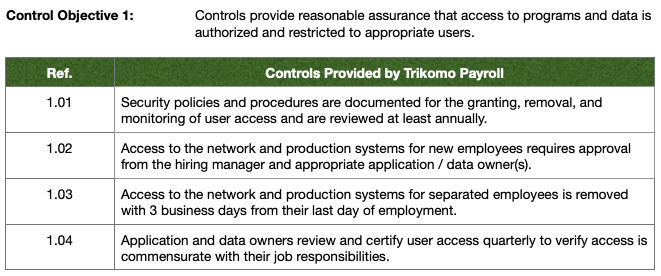
Example SOC 1 control matrices for an access control objective. This is not a fully fleshed out objective and is just being used for illustrative purposes.

Topic #1: Hiring Process

The hiring process typically includes various controls that need to be completed prior to an employee being granted access. These controls can be included to provide a beginning-to-end employee lifecycle, but would most likely be assessed moderate or low control significance during the controls risk assessment.

  • Employees are required to pass a general background check prior to their first day of employment.
  • Employees are required to complete security awareness training on their first day of employment and annually thereafter.
  • Employees are provided the employee handbook upon hire, which documents the company code of conduct and authorized use of computer resources, that they are required to sign as an acknowledgment they read the handbook.

Topic 2: Split Access Controls

The process for granting an employee general network access at hire is different than the access required for specific job functions. For example, a payroll analyst would require role-based access to the ERP (Enterprise Resource Planning) system while a system administrator would require privileged access to 1 or more systems. These controls would be assessed high control significance during the controls risk assessment.

  • Application-level permissions are approved by the application/data owner and assigned based on custom configured user groups based on employee role to ensure permissions promote appropriate separation of duties.
  • Administrator-level permissions for network infrastructure (e.g, servers, firewalls, etc.) is approved by the CISO and is restricted to personnel who require elevated access to perform administrative job functions.
  • Access for administrative roles requires multi-factor authentication (MFA).

Topic 3: Authentication Controls

Authentication controls include minimum password length, password complexity, and account lock-out mechanisms for when unsuccessful attempts to access an account reach certain thresholds. The account lockout would include maximum attempts before getting locked out and a lockout duration, which lowers the risk of attackers guessing passwords to access the system. Authentication controls would be assessed a moderate or high control significance during the controls risk assessment depending on how the control objective is phrased.

  • Operating system, application, and database passwords are configured for strong user authentication parameters, including password length, password complexity, user account lockout on invalid attempts, and password change intervals.
  • User sessions are automatically logged out after 30 minutes of inactivity.

The option exists to be more specific regarding password controls. For example, the minimum password length can be listed (e.g., 10). However, by leaving it a little more generic, the service organization can point to the policy for the auditor to use as a baseline for testing. Also, depending on how systems are integrated, password controls might be different for all systems/applications or the same when integrated with single sign-on tools.


Topic 4: Monitoring Controls

Controls to monitor user access can be split between general network, applications (with role/permission review), and privileged access (administrative) permissions, with different frequencies that align with their risk. For example, a general review of access to the network to ensure no separated employees continue to have access might be completed annually while an administrator access review might be completed monthly. Monitoring controls would be assessed a moderate control significance during the controls risk assessment.

  • System administrators review network user access reports annually to verify access for separated employees was disabled and/or removed.
  • ERP module owners review user access reports monthly to verify access is current and appropriate based on the users role within the system.

As you can see, this can result in 10+ controls supporting a single control objective, which opens up the option of splitting the control objective so it’s more focused. For example, a control objective can be added that focuses on the hiring process or the control objective can be split to focus between general network access and administrative access to network infrastructure (e.g. servers, firewalls, IDS).

The decision to split the control objective or include more controls in a single objective can depend on the size and complexity of the environment, contractual requirements, or industry standards (e.g., NIST). And, as noted in the previous post, there’s a lot of grey area that goes into these decisions that requires professional judgement on the part of the service auditor when making recommendations during a readiness assessment or planning for the examination.
SOC Report Structure / Overview

System and Organization Controls (SOC) reports are pretty easy to read once you get a handle of how they’re structured. The reports are typically made up of 4 or 5 sections, not including the cover page and table of contents.

The section details below are provided to give a general idea of what’s included in each section. However, they’re not all inclusive. I’ll go into more detail regarding some of the sections in later posts.

Section I: Independent Service Auditor’s Report

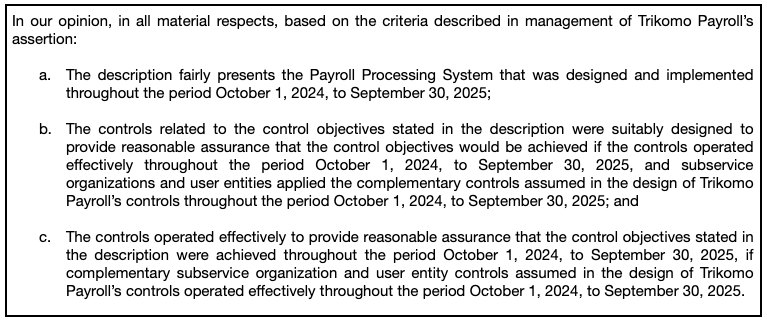
The Independent Service Auditor’s Report includes the scope of the engagement, service organization and service auditor responsibilities, and most important of all, the auditor’s opinion. The opinion will include 2 or 3 statements depending on if it’s a Type 1 or Type 2 report.

A Type 1 report will indicate the description is fairly presented and the controls related to the control objectives were suitably designed as of a specific date (e.g., September 30, 2025).

A Type 2 report will indicate the description is fairly presented, controls related to the control objectives were suitably designed throughout the period (e.g., October 1, 2024 – September 30, 2025), and controls operated effectively to provide reasonable assurance the control objectives were achieved throughout the period (e.g., October 1, 2024 – September 30, 2025).

Example SOC 1 Type 2 Opinion

Section II: Management Assertion

The Management Assertion documents, from the management of the service organization perspective, the services included in the scope of the report, any services completed by subservice organizations (if applicable), acknowledges the service organizations responsibilities in fairly presenting system, and that the controls were suitably designed.

The service auditor will typically provide a Management Assertion template to the service organization for review and completion. The service organization has a choice to sign or leave it unsigned in the final report.

Section III: Description of the System

The Description of the System provides an overview of the service organization operations and controls in narrative form. There are certain aspects that are required to be included, while others can be limited by just referencing the control objectives and controls documented in Section IV. I’ve found the best system description includes more detail than just the control objectives / controls and provides a cross reference of controls between both sections.

This section also includes complementary controls for both users (service organization clients) and subservience organizations.

Section IV: Tests of Controls and Results

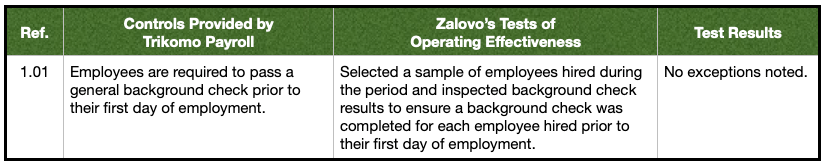
Control objectives, controls supporting each control objective, tests completed by the service auditor, and test results are noted in this section, typically in table format. The test results would note if any exceptions were noted during testing, even if the report has a “clean opinion.” The best case scenario for the service organization is for the test results to note something in line with “No exceptions noted.” for each control.

Example control, test of operating effectiveness, and test results.

Section V: Other Information Provided by the Service Organization (Optional)

The Other Information section is optional at the discretion of the service organization. Some companies will use this section to provide additional information about their organization that was not included in the description of the system. This can include other services provided by the organization or future plans for the organization.

Also, in the event there were exceptions / issues noted during testing that were reported in Section IV of the report, some organizations will include additional background regarding the exception(s), action plans to remediate the control weaknesses, and if the action plans were already implemented.

The service auditor will review this section for adequacy, but it’s not subjected to the same procedures applied in forming an opinion. In other words, this section is not tested by the service auditor.

The Manager Assertion, Description of the System, Control Objective and Controls included in the Section IV, and Other Information sections are all provided by the service organization. The only sections / parts noted above that are technically completed by the service auditor are Section I and the tests of operating effectiveness and test results columns included in Section IV.

SOC Order of Operations

Every so often when scrolling through the interweb I’ll come across a headline stating “95% Get This Simple Math Problem Wrong”. Although some are truly difficult, and I’m not really a fan of the headline, many times completing the equation is just a matter of using standard order of operations. I learned it as PEMDAS growing up (Parentheses, Exponents, Multiplication/Division, Addition/Subtraction).

Although not as stringent, for companies looking to get started with System and Organization Controls (SOC) examinations, there is a recommended order of operations for completing the SOC examinations.

Readiness Assessment:

A readiness assessment is an informal assessment of the organizations policies, procedures, and operations. It’s an ideal starting point for start-ups and companies that haven’t previously completed a formal internal controls examination.

This is an ideal time for the service organization and service auditor to review client contracts to determine what requirements are documented, quantifiable, and can be assessed through an examination.

In essence, it’s a practice run to identify gaps in compliance before undergoing a formal examination to avoid unexpected delays, failed controls, and modified opinions.

Type 1 Examination:

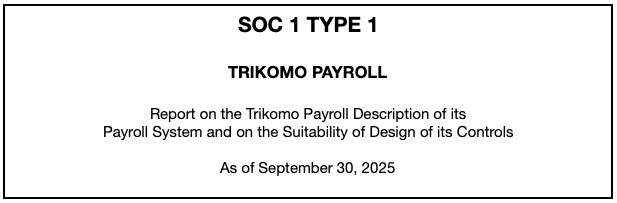
A Type 1 examination assesses the design of controls as of a single point in time. For example, a Type 1 report will typically indicate “As of September 30, 2025.” The report can be used by service organizations to demonstrate to their clients that they’ve implemented formal processes and controls.

It’s common for the Type 1 examination to be completed in short order following the readiness assessment if no major gaps or controls weakness are noted, which can lead to efficiencies and lower the overall cost of the examination.

However, if major gaps or control weakness are noted during the readiness assessment, the Type 1 examination will likely require starting from scratch, after the gaps or control weakness are remediated. Some or most of the evidence previously obtained during the readiness assessment would no longer be valid months after the fact.

Example SOC 1 Type 1 cover page.

Type 2 Examination:

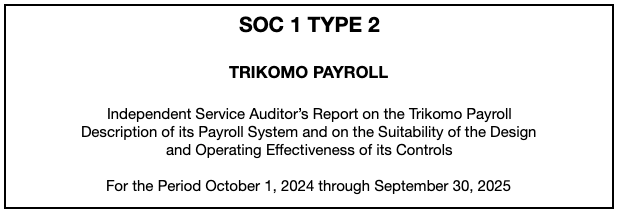
A Type 2 examination assesses the design of controls AND operating effectiveness during a period of time, usually 9 or 12 months. For example, a Type 2 report will indicate “For the Period October 1, 2024 through September 30, 2025.” This examination involves obtaining populations from the assessment period and selecting a sample of transactions from the population for inspection (testing).

There are unique and rare cases in which the period of time for a Type 2 examination is 6 months. Also, in rare cases, some organizations will complete Type 2 examinations for a 12-month period on a rolling 3-month basis for more continuous monitoring.

Example SOC 1 Type 2 cover page.

There’s no requirement to go in the above order of operations. However, this approach leads to the best results for the service organization and their clients.